In September 2026 I went to Agile Cambridge conference, for 2 days of learning and meeting people. This was a good excuse to read the notes from my last visit (lots of good stuff in there!), and decide what notes I’d like to share this time.

Lots about AI, of course
If you’re reading this post a few years after 2026, it’ll probably all be a lot clearer about what things AI is useful for and how people and teams will work with it. But right now, at this conference and everywhere else in the industry, things seem to be changing fast and loads of people are trying to predict the near future.
Vernon Richards voiced a common concern in Now What? If The Robots Can Do My Job, What Do I Do?, describing his own reaction to news stories about companies laying off software engineers and betting on AI. He was feeling like he had limited choice: either get interested in how this works, train agents to do his job, and then not be needed and lose his job … or refuse to engage with it, don’t train agents, and then lose his job anyway. Was there another option?
He’s found a way through it: by identifying his own skills and what he’d like to spend time on, Vernon’s focused on helping teams and the whole org deal with the accelerating rate of code production. He’s always been interested in testing and quality, and now there’s a real gap in being able to understand risks and reasons for failure in systems that are getting ever more complex.
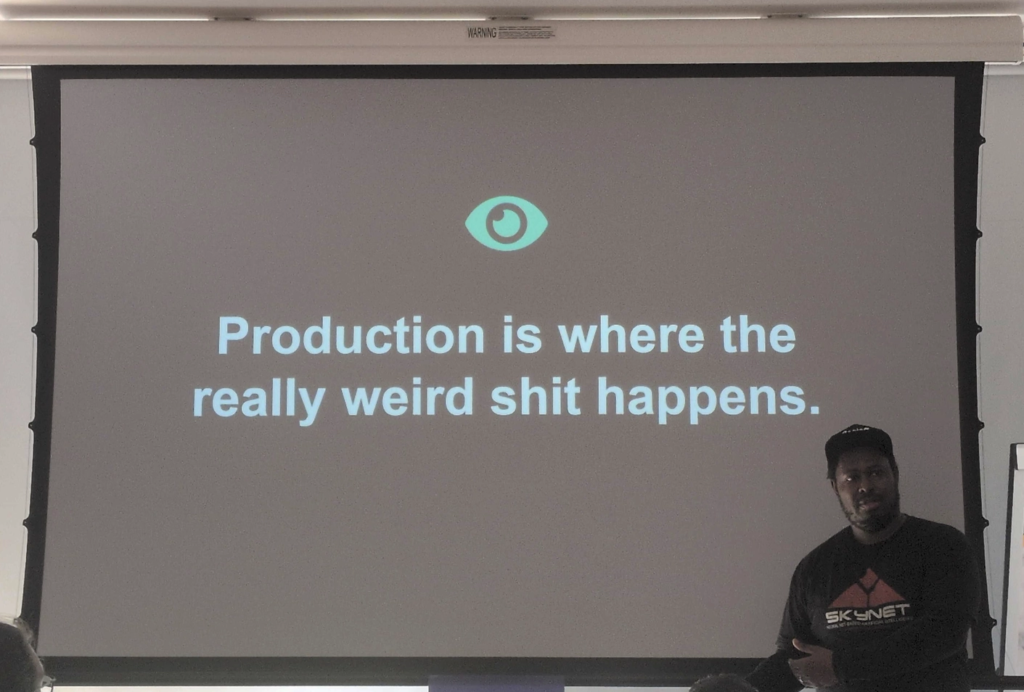
Vernon’s own writeup on his “Yeah But Does It Work?” site has plenty of details about how he changed focus to measuring impact, choosing where to spend your time, and building reusable tools. It’s a good read.
For another look at uses of AI, Nicolas Brown’s Talk to my agent: scaling product and flow expertise with AI showcased an assistant Nicolas made to help a client’s product teams learn agile ways of working. He used Copilot Studio to make a virtual “clone” of himself: an agent that can help them learn and work with flow metrics and forecasting.
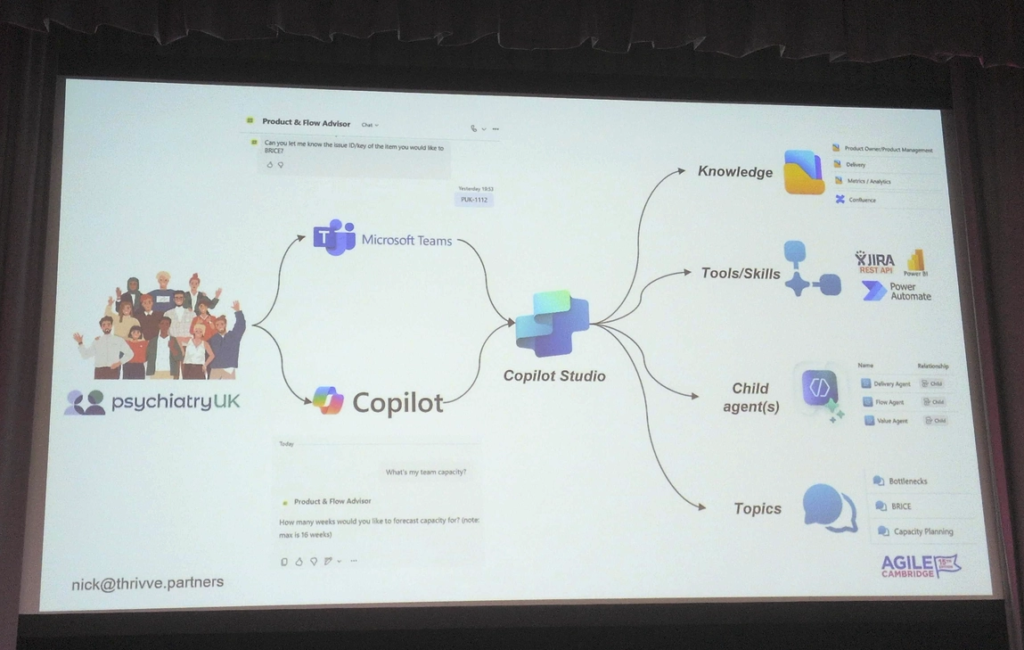
- Doesn’t search the web; uses various knowledge bases inside the org about the way they’d like to work.
- The org has a flow forecasting tool (using Dan Vacanti style agile metrics) but many people find it daunting; this agent can see your team’s stats and use the tool to make forecasts or suggest interventions to improve flow.
- Can give it transcripts of standups, Miro boards from retros, or other things to look at, and get feedback and coach-style suggestions on how your team might improve.
There’s a lot going on with this tool! Nicolas gave a similar talk at Flowtopia 2026, have a watch of the video if you want to see all the details.
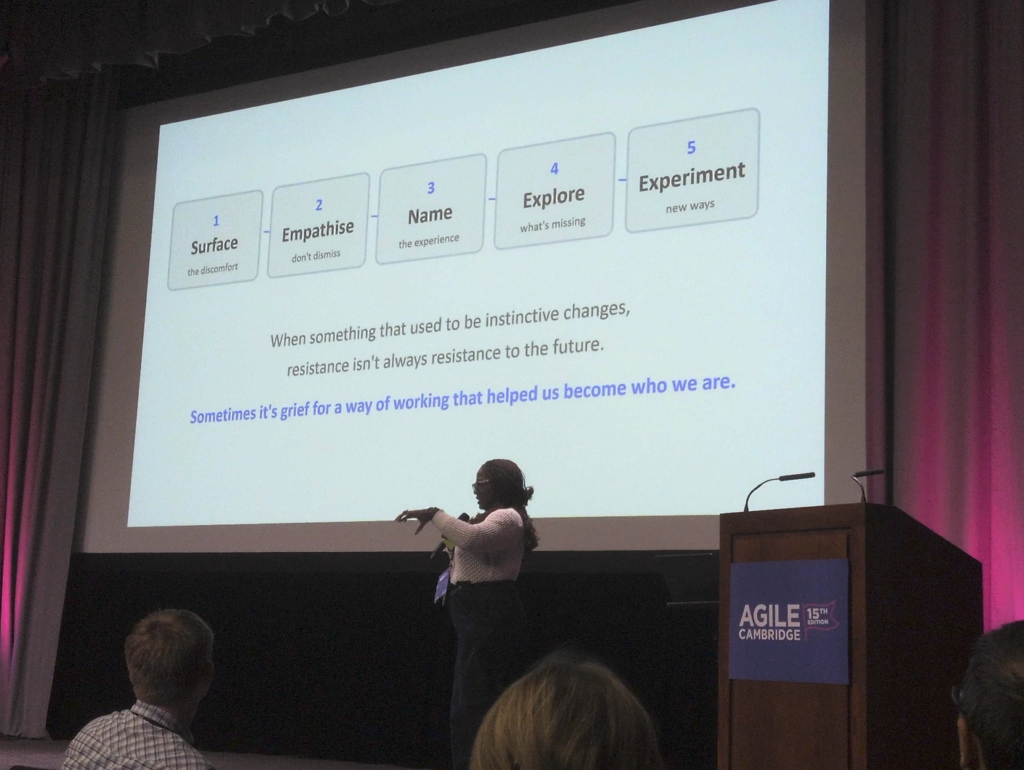
Final AI-related mention: Tutu Ariyo gave a thoughtful lightning talk on understanding how your team might be feeling as AI changes the way they do their jobs and helping them navigate through it. Tutu’s shared her talk video, see AI transition: developers grieve their craft, find new ways.
Some very human topics
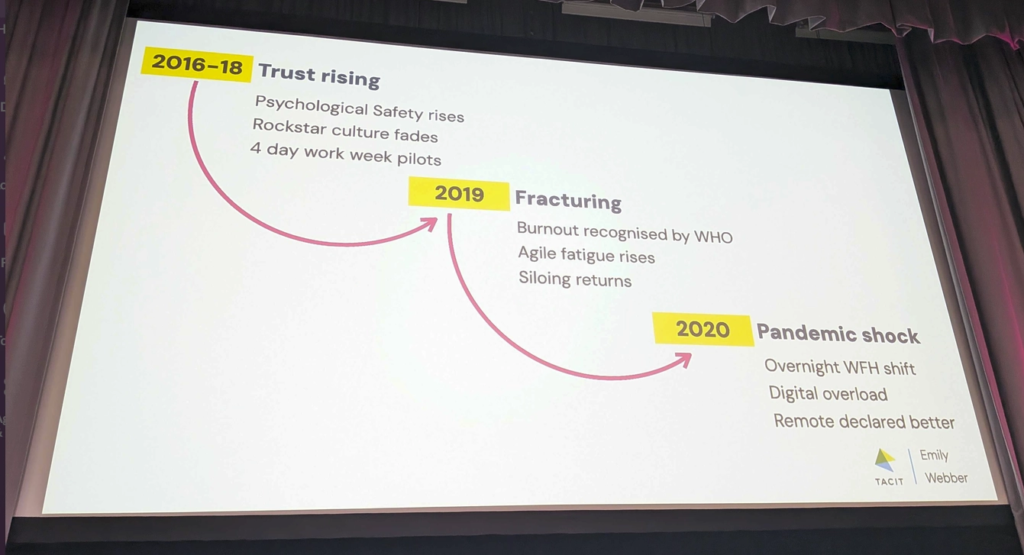
Emily Webber’s Communities of practice: Still here, more relevant than ever took a look at how much has changed since she stood on this stage 12 years ago with a case study on building a delivery community at Government Digital Service. Lots has changed in the world of work since then.
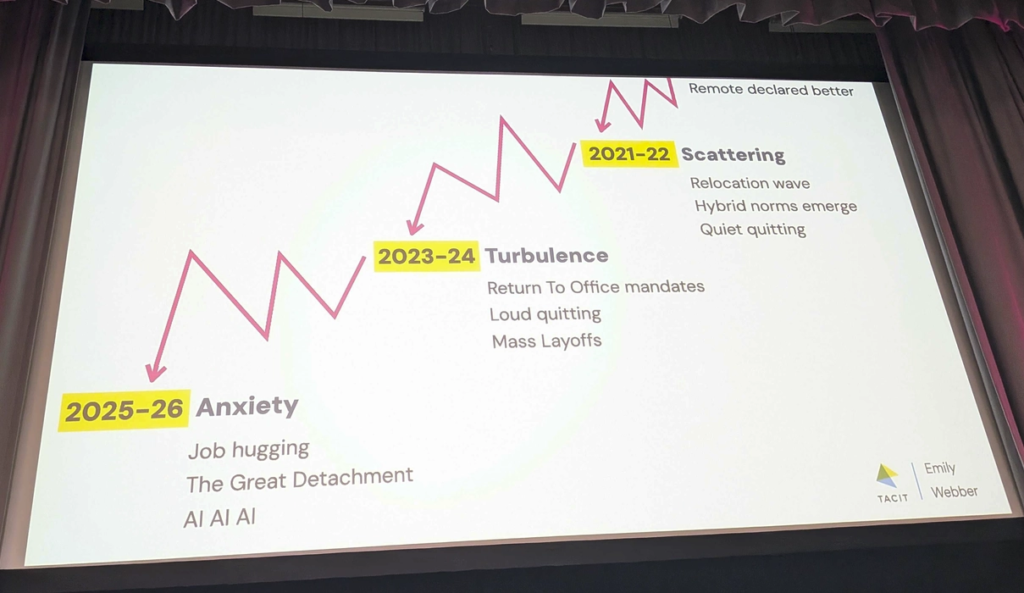
Emily referenced a few books:
- The Happiness Advantage (Shawn Achor): “The people who survive stress the best are the ones who actually increase their social investments in the middle of stress, which is the opposite of what most of us do.”
- Social Physics (Alex Pentland), which describes lots of studies that tracked who’s emailing or talking to who in large organisations. Orgs where people communicate across silos tend to perform better.
- Emily’s own Building Successful Communities of Practice, with its just-launched second edition that covers everything she’s learned and everything that’s changed about CoPs in the 10 years since the first release.
Emily called out 3 big changes in communities of practice in the last 10 years:
- More distributed (which doesn’t have to mean disconnected – see Agile in the Ether for a community that rarely meets in person but who know and support each other well)
- More embedded (which can work well – giving more support and visibility – or poorly, if you pile on pressure and mandate contribution)
- Trying to operate at larger scale (which shouldn’t mean adding hundreds of people to the same channel and meeting invites – see Emily’s model for nesting connected groups for a better approach).
Emily shared lots of tools and models you can use, along with the slides from this session.
In another people-focused talk, Bernadeta Nikrevičė’s Too smart to collaborate? described a challenge she’d been working on: how do you deal with a team member who’s very confident and knows best about everything?
The intro included “Every technique we’re about to hear is a plan B … plan A should always be to try having a 1:1 conversation”. Following up incidents of unhelpful behaviour with a “what happened / why it matters / what I expect” conversation can often fix things with no further work needed. But if you need more things to try…
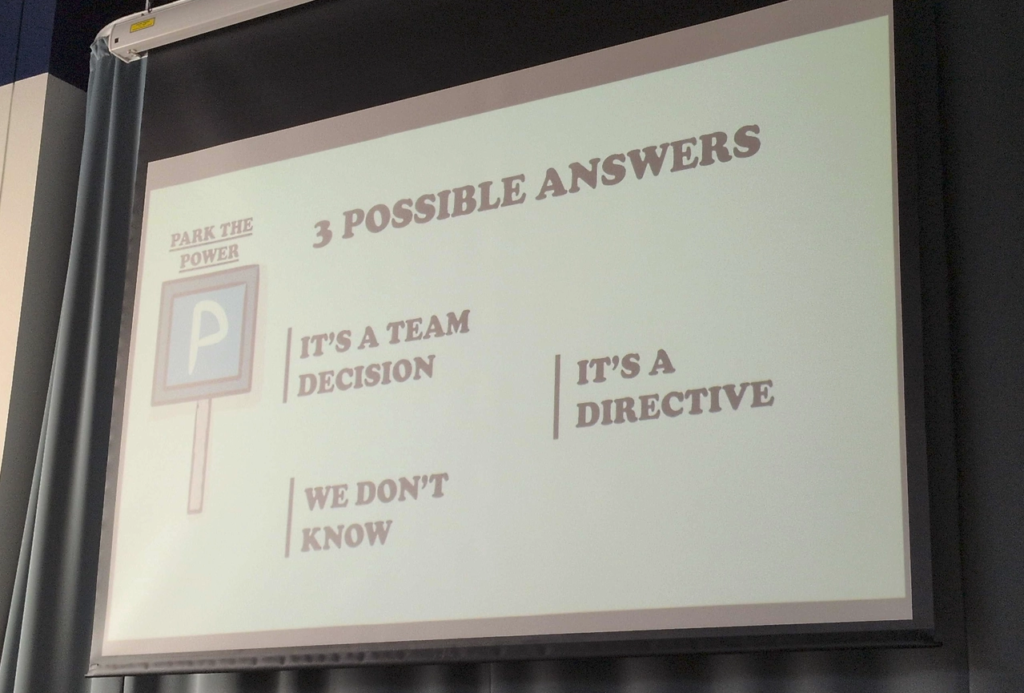
- Avoid listening to ideas only because someone’s senior or dominating. Agree how we make decisions (based on product goals, user needs, metrics …) and ask anyone who states opinions how their suggestion relates to these.
- Don’t let people be shut down when they try to make suggestions: if someone says “not that”, ask how this decision is getting made.
- If it’s a team decision, let’s hear from the team
- If it’s a directive, say that
- If we don’t know (surprisingly common!), work on that – this being undeclared is what leads to power games.
- Some people feel like “if my idea loses, I lose”. Bernadeta let us try out a format similar to Liberating Structures’ 25/10 Crowdsourcing as a way to help people get less attached to their ideas.
Bernadeta shared her slides afterwards, and if you’d like to hear more from her there’s a good Coffee and Bytes podcast episode.
One more talk on the people theme: Jenny Martin’s Knowing Me, Knowing You….. Ahaaa! was full of good advice, including “We need well-rounded teams, not well-rounded people” and “Each person’s greatest room for growth is in the area of their greatest strengths”. You can be much happier and more successful if you focus on working out what you’re great at and improving those things, rather than trying to “plug the gaps” in some list of competencies.
Jenny recommended tools for understanding your personality better and discovering your strengths, including the Big Five personality traits. I first heard about those at my first visit to Agile Cambridge (in 2017!), where Dr Brian Little talked about the puzzle of personality. Unlike lots of other personality tests this one seems very evidence-backed.
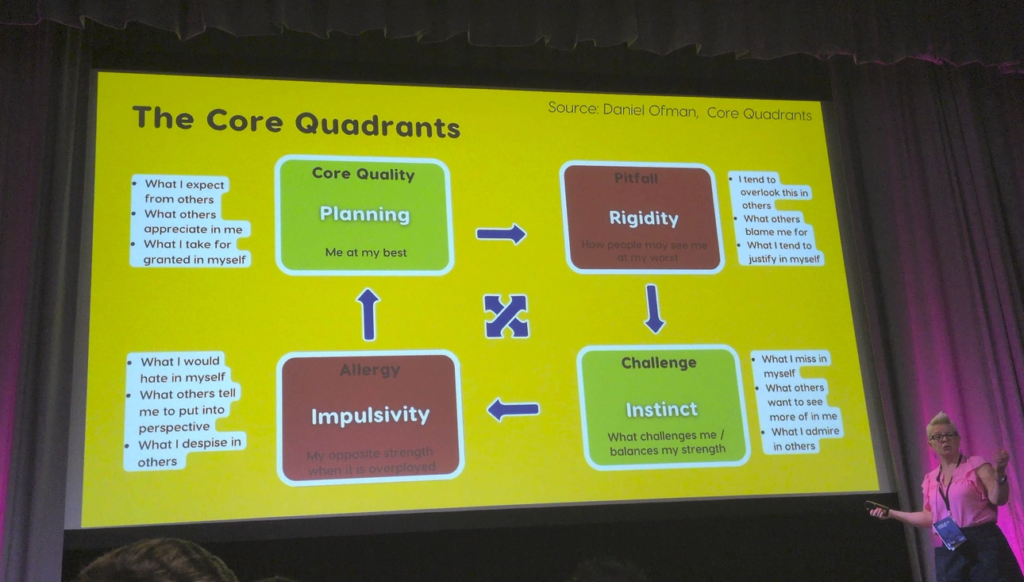
Jenny also talked about watching out for overplayed strengths, using the Core Quadrants tool from Daniel Ofman (I’ve tried this and recommended it when starting something new, very helpful!) For example: If you’re naturally good at creating harmony, you might avoid necessary conflict, be perceived as weak and indecisive, sacrifice your own views for the sake of harmony, be overly deferential to experts…
More from Jenny:
- A recent Mind the Product podcast appearance
- New inclusive facilitation guidelines you can download
- And a brand new book and accompanying website: OOPSI! With Miro template, intro videos, and more.
So much more at the conference
I can’t write about everything I saw at the conference or this post would turn into a multi-day read. Let’s mention just a few more things …
Dan Abel helpfully wrote a blog post, multiple preview articles, and gave links to further reading for his talk Cut here first: sequencing your way out of legacy. No need for me to add anything more except to say it was a very useful set of ideas for tackling a problem lots of us have faced, but everyone seems to struggle with.
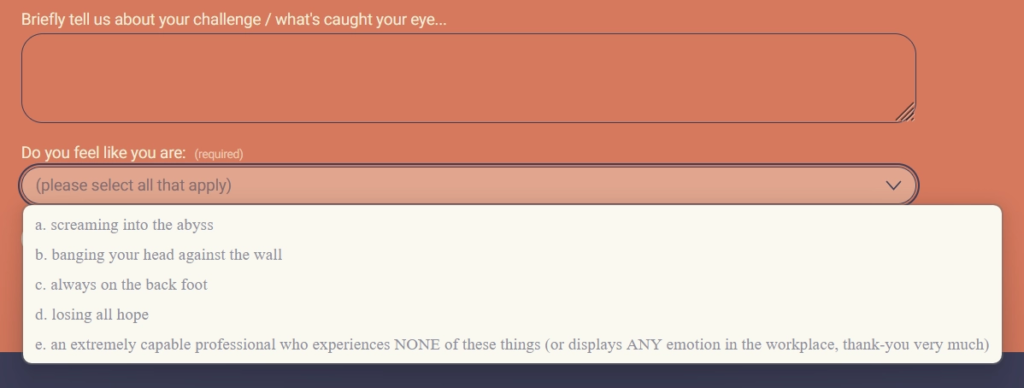
There’s always too many interesting tracks on at once, so I was sorry to miss out on Ceri Newton-Sargunar and Kara Daly’s How to lose your people in 90 days. Ceri’s description online makes it sound so useful … but there’s no follow up blog posts or anything so far, I’ve missed out! I do like the website for Ceri and Kara’s DBA Insights company – lots of interesting case studies and possibly my favourite-ever “contact us” form:
And the last thing I’ll mention: my own workshop. I’m certainly adding “Taught Rubik’s cube solving at the University of Cambridge” to my CV next time I send it out. For more about cube solving and how it relates to software algorithms, see Algorithms IRL: Let’s solve a Rubik’s cube!

Leave a Reply