One of the most useful early lessons I learned in coaching was: it’s not about me sharing or recommending what I’d do in a situation, it’s much more helpful to leave my advice out of it and help the client come to their own conclusions. Mentoring, teaching, and other “I have experience in this area” techniques are all very useful, but they’re different from coaching and I should resist the urge to shift into those when someone’s asked to be coached.
And yet…

Feeling like I was missing something
I was coaching someone once who wanted to get better at how they worked with people — their manager, peers in other roles, people in other departments — after hitting various challenges with them. I tried some good coaching questions, but the answers didn’t lead anywhere: “What else could you try?” got “I don’t know”, and “Where might you go for ideas?” got “Well … to you?”
They were a bit frustrated by my “the answers are within you” approach, and I could sympathise. On my coach’s profile page I had described some of my skills, and they’d seen “stakeholder management” on there. Sounds like I’m experienced in exactly the thing they don’t know about, so why am I not giving advice?
I was still sure coaching rather than mentoring or teaching was useful in this case — all my thoughts about them having more context and getting more value out of solutions they choose themselves felt very relevant — but if it’s a topic they feel all at sea with, surely there’s a way to help them benefit from my experience. And I know lots of established coaches concentrate on particular roles or industries, so there must be some way they’re using their own expertise to help clients.
This helped me realise I’d once again missed something important about coaching, and prompted me to talk to my supervisor (I very much recommend finding a coaching supervisor if you want to practice!) and to do more reading / discussing on this topic.
My experience with sharing my experience
There’s a continuum of coaching styles, visualised nicely in this diagram from Bigrock:
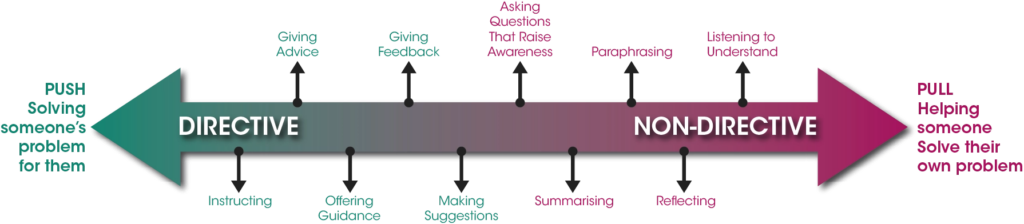
Over on the right are the non-directive approaches that helped me get so interested in coaching in the first place. The useful thing with this diagram is that it shows it’s fine to move towards “solving someone’s problem for them”, so long as you’re aware that’s what you’re doing: you can move left and right on this scale, giving more direction if the client needs it but looking to move back to the other side once that specific need’s met.
Sometimes sharing your own expertise is the right thing to do, but lots of times it’ll feel like the right thing to do and you should decide not to. Frequently, when someone describes a challenge in some area I think I know about, I get a strong urge to explain how I’d tackle it. Some of that comes from a common human urge to prove you’re valuable (”look! I have knowledge and smarts!”), and some of it comes because we’re so used to mentoring (advice-giving) being the default. The Secrets of Consulting book reminds us to listen for the request for help.
Ron Jeffries (of Agile Manifesto fame) has some excellent cautionary advice to help me avoid assuming I have the answers:
“We did X and were successful” does not imply “X helped us be successful”, much less “X is the best choice we could have made”, much less “X is therefore something that you should do”.
— Ron Jeffries, Starting Out: What works, how fast and why?
A Commonplace Expertise podcast episode has a great discussion about the role of a coach (coaching discussion starts at 41:30). Eric Nehrlich describes realising the most useful thing he could do: “Understand where people are, and help them see some new possibilities that could get them unstuck”. And he says hearing an interview with Jerry Colonna helped him realise that even when you do have the “right” answer, it’s not always useful to share:
CEOs come to me and they want me to give them answers. And I know if I give them the answer, I am reinforcing the worldview where they can’t figure it out themselves. And I never want to be that coach.
— Jerry Colonna, quoted by Eric Nehrlich
Last tip: I’ve found the skill/will matrix is a helpful framework for deciding how to approach this topic. When talking through a challenge, people will often be somewhere on this 2×2 grid: either high or low skill (they do have knowledge and experience that’s help them tackle it, or else they’re a bit at sea), and high or low will (they are motivated and confident to get this sorted, or else they’re held back by being hesitant or unwilling).
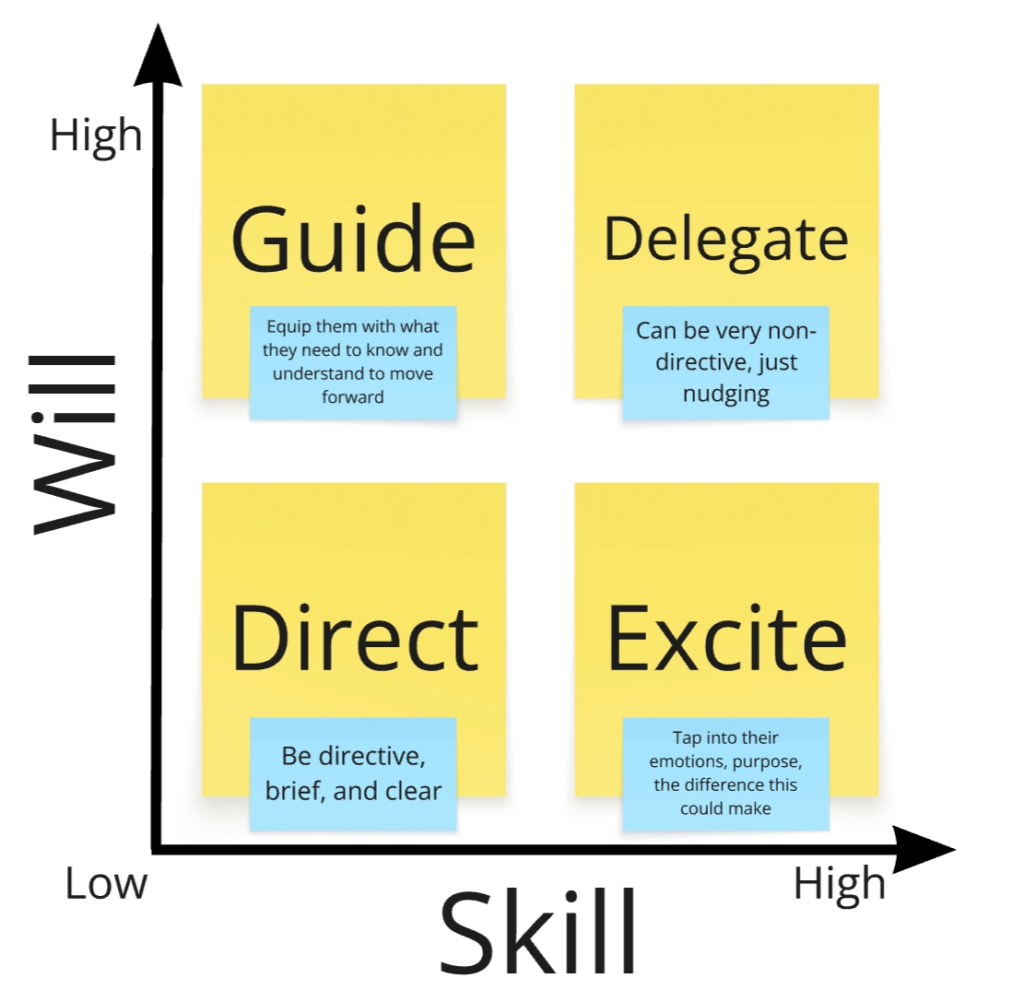
This “will” isn’t a measure of someone’s general outlook, it’ll be different for specific challenges — for example, I consider myself motivated and “high-will” in lots of situations (”I have the skills for this!” or “I’ve never done this before but I bet I can learn!”) but ask me to do some things in SharePoint and my will is non-existent (”I have no ability to do this and have no interest in getting better at it”).
You might talk someone through the matrix and ask them to place themselves on it for their current challenge, or you might just keep this matrix in mind as they talk through the challenge. This gives you some clues about what might be a useful approach:
- If someone’s in the low skill / low will section, asking lots of coaching questions will likely just frustrate them. It’s important to meet them where they are, and offer support — a good time for those “straight answers” to be offered.
- If someone’s low skill / high will, you can be directive in offering information, but not directive in what they should do with it. After talking through recommendations from their experience, you can ask “Which of these concepts will you take further”, “How will you do that?”, moving back into the more usual coaching mode.
- If someone’s high skill / low will (we all have some skills we’d prefer to never put to use again), you can help them explore whether this really is “one more time” using these skills is what they want to do, and whether there’s any new angle they can bring to it: pair with others so they can take on this work in future? Make visible the effort it takes to get to a good outcome, to help people get motivated to change how often this tedious work is needed?
What was that about stakeholders?
Earlier in this post I mentioned someone who came to me for stakeholder management advice. If you’ve been thinking “hey I’d like to hear what advice you can offer”, here’s a few notes.
Early in my career, I thought my role was to make sure everything went brilliantly to plan, as that’d keep everyone happy. This is rarely possible! In almost every endeavour, some amount of disappointment is inevitable. I’ve written up a workshop format that lets you get ideas from my experience, and compare stories and ideas with others, on how to disappoint people.
Understanding where stakeholders might be coming from is important; too often I’ve thought the problem is that “they” just don’t “get it” when I’m at a loss to understand why a conversation’s not going well. Talking to others who have similar challenges has helped me consider more perspectives — I’ve made some notes after learning more about bureaucracy (not just there to annoy you), making change stick in a large organisation, and what we talk about when we talk about estimates.
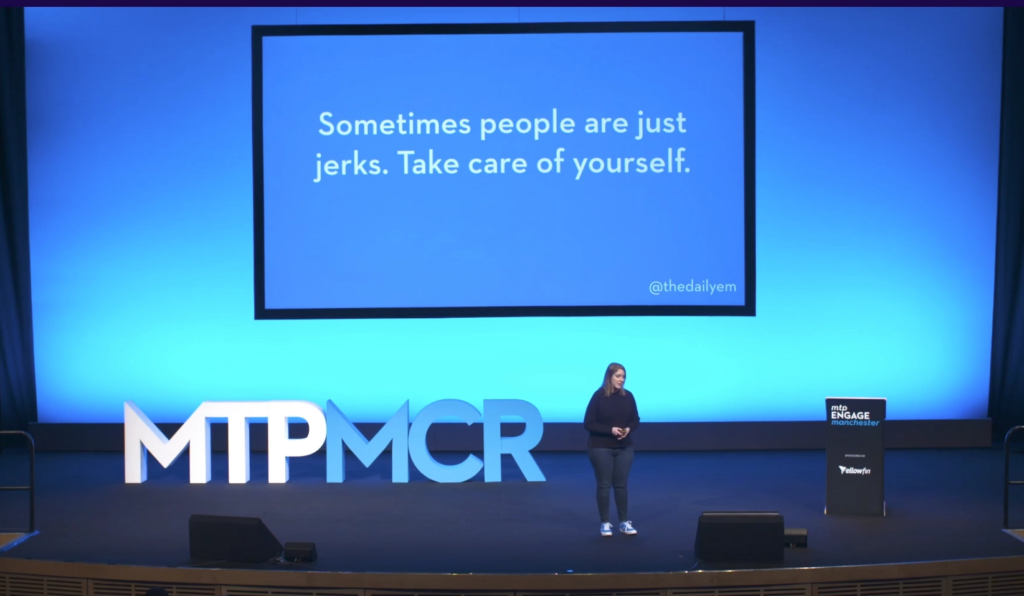
Possibly my favourite-ever talk I’ve seen about stakeholder management was Stuck in the Middle by Emily Tate: after lots of valuable advice about how you can adapt and work with people better, she brought out a point that lots of us fail to consider when we’re working very hard to makes things go well.
More about coaching
We’re building up a nice collection of topics, nice to find so much by looking back!
And there’s still more to come.