I recently wrote a few things about coaching and said I might start a series of coaching notes. Here we go!
In that post I mentioned my early habit of breaking into coaching conversations at every opportunity. While coaching’s often useful, it’s not the answer to every question — and and even if I think it’s just what someone needs, it’s better to let them decide that for themselves. One challenge: Most people have never heard of coaching, and default to mentoring requests.

Lara Hogan has written lots about the difference between mentoring, coaching, and sponsorship:
- Mentoring involves finding someone experienced in the type of challenge you’re facing, and asking them what advice they have for you (how would they approach it / how would they suggest someone at your skill level approach it). There’s lots you can learn about making mentoring effective — it’s a valuable approach!
- A problem with mentoring is that lots of us don’t realise there’s other types of help you can ask for or offer. An introduction to coaching can let people think about a different path: maybe there isn’t a “right” answer you can be given, there’s only “good answers for you” and you, personally, are the best person to decide what those good answers might be.
- Lara points out that there’s another option: sometimes people don’t need any help to develop more skills, what they need is opportunities and someone to mention their name when they’re not in the room. “What does sponsorship look like” talks through this.
Making things formal
Coaching can be a “stance” you decide to take on when someone asks you a question or brings a challenge — a more open question rather than jumping to giving out an answer. Or you might ask if a coaching style of conversation sounds useful (remember, “do you want a straight answer” is often a good start).
Another option is to do “contracting” before starting a series of coaching sessions. That’s a funny term (often you’re offering to help someone you work with, and there’s no legal contract or money changing hands, but “contracting for coaching” is a good term to search for (here’s one nice example). You can call it “let’s talk about how we’ll work together” and “here’s a write-up of what we agreed to”. Having a conversation up front about how coaching works, what the “client” (person receiving coaching) is hoping to get out of it, and how you’ll tackle various difficulties that might come up, is a wonderfully useful way to start. And having it written down is perfect for helping check whether any of what you both hoped for is coming true, and deciding if anything needs changed.
Agreeing a goal and setting a duration for working together on it (e.g. we’ll meet for 6 one-hour conversations) is a great way to stay focused — coaching can involve opening up your viewpoint and exploring all kinds of tangents, or tackling something huge and nebulous, so coming back to “achieve something in this area in that time” can help converge back to making a decision or small improvement. It also makes a good natural “shall we leave it there” point:
- Often I’m happy to carry on for another “season” as many times as is useful, but having a point to reflect on what’s happened and discuss whether we should leave it here is very useful.
- For both coaching and mentoring, leaving things open-ended can lead to the arrangement carrying on indefinitely because nobody wants to say it isn’t useful any more. Setting goals and duration shifts the conversation: is carrying on further the most useful thing for you? What would we want to get out of the next stage? Or, is it time to go look for a different coach / mentor / work on things alone?
- This structure lends itself to reflection and feedback — we have x sessions left, or we’re at the end of our series, how did you find it? — and can be an excellent way for people new to coaching to try it out and experience whether this gives them anything different than the mentoring-style support they may be more used to.
Talk about challenges you know are coming
You can use this contracting step to set the coaching engagement up for success, choosing to pay attention to anything you suspect might get in the way. For example, I’ve worked with people whose work is very busy and often good intentions to spend time on “important but not urgent” things gets swept away by the next “emergency” that breaks out. If you know that’s a risk, you can frame the coaching discussion around giving coaching the best chance of succeeding despite all these things we know will get in the way.
- Pay attention to the goal: what change do you hope to see come out of this work? How much difference would that make if you achieved it? What would life be like if you didn’t achieve this change? Is that the most important thing you could invest time in changing? If not, should we focus on something else?
- I’ve written before about goal setting, including “the 4 disciplines of execution”, which is helpful framing for busy environments. “focusing on any improvements or goals can feel impossible, as the whirlwind sweeps up your time”.
- Pay attention to when you’ll meet, and when the client will work alone on actions they take from the session. Look at diaries and block out specific chunks of time. I’ve seen an issue where the coaching sessions themselves seem great — insightful reflections and resolutions to take some actions before next time — but very little actually come from them, as next time we meet the client’s been too busy to do anything we talked about. If you both know that’s a risk, try carving out this time.
- Talk about what you’ll do if these plans don’t work out. It can feel a little awkward bringing this up before anything’s gone wrong … but much less awkward than bringing it up once things have gone off the rails. And setting boundaries at the start can really help this important arrangement have a fighting chance when other work deadlines and fires crash in.
All this might feel like far too much depth for your situation — and that’s fine, you may be right! Think about what challenges each particular engagement might have and use the contracting discussion to focus on that.
Contracting, except smaller
Esther Derby has lots of advice about contracting — her podcast episode “Contracting sets the tone” is a nice example. I attended a webinar Esther ran in 2021, and have some notes that are relevant to this post.
Esther talked about this consulting role grid that can help clear up expectations when you’re arranging to come and help someone with a challenge.
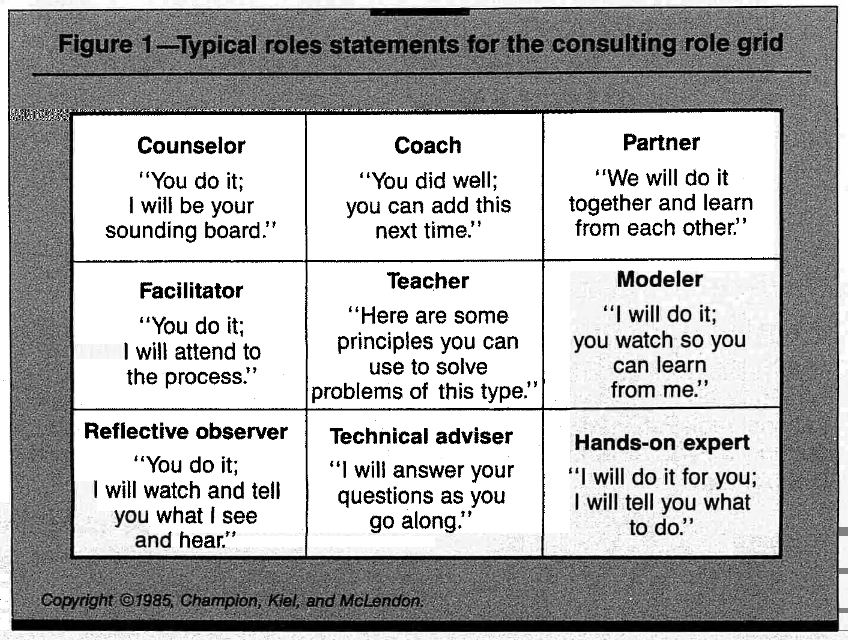
In addition to using it in up-front “let’s agree how we’ll work together” conversations, Esther’s found it useful during ongoing work to help explore friction, with conversations like “oh, you were expecting me to be a teacher but I’m acting more as a reflective observer”. When roles and expectations aren’t set at the start, this can be brought up any time to explain preferences and talk about adjustments.
This idea led on to some more general advice from Esther: Always Be Contracting.
There’s lots of day-to-day opportunities to talk about how you’re going to work with someone:
- “What do you want to get out of this session / meeting / interaction today?”
- “How would you like to achieve that?”
She also recommends a technique she calls “permissioning”: If you ask unexpected / uncomfortable questions without asking permission first, people can feel like they’re being interrogated. This is especially true if there’s a status difference (in either direction). Asking “Is it OK if _____?” when you want to dig into the why of something, or shift to an unexpected topic, can help build a little bit of safety.
Wrapping up
Reading old notes and thinking about what I’ve tried with this topic has been helpful — there’s lots of good techniques I used to use but it’s easy to slip out of the habit.
I’ve also spotted a link: In the contracting webinar, Esther recommended the book Flawless Consulting by Peter Block. That’s the same book I noticed Gerald Wineberg enthusiastically recommend when I re-read The Secrets of Consulting recently. And … that book’s sitting on my bookshelf. Looks like I noticed both these recommendations first time around but never got round to reading the book! Time to fix that …