I’d seen recommendations for this book in lots of places, for years, before I got round to reading it. I assumed it’d be long, serious, and probably not too relevant to me (my job isn’t consultancy). I was wrong! It’s short and funny, with handy advice for people in all kinds of jobs.
I’ve made some notes on things I’d like to remember — maybe this post will be helpful for other people too.

A definition of consulting
“The art of influencing people at their request”.
This is wider than the usual definition I’d have thought of. The author notes:
- This can be an official title, but really you’re probably acting as a consultant in many parts of work and life.
- “Most likely, you already are a consultant, because you become a consultant whenever you accept someone’s request for influence.”
The last part of the definition feels like an important one. In some roles you can make individuals, teams or organisations change how they do things — but it’s much harder to help them get benefits out of these changes. And in most roles you can offer to help (with coaching, workshops, advice) and people will let you … but maybe won’t make time to engage with what you’re offering, or make much effort to implement and stick with any changes. Author’s advice sounds applicable to all kinds of consulting:
Never allow yourself to forget that consulting is the art of influencing people at their request. Among consultants, the most prevalent occupational disease is offering unsolicited “help.”
If I took nothing else from this book, I think this advice would stay with me! It’s repeated in different versions throughout, including clarifying that “Implicit involvement isn’t good enough. Make sure that you’ve actually been asked”:
It’s one of the ironies of our business that consultants rarely get asked for help by the people who need help the most. That sometimes makes it tempting to jump in without being asked when you happen to be in the neighborhood. Don’t! When the request is missing, chances are you can’t help.
Being OK with not achieving much
“Sherbie’s Laws” are interesting to reflect on (why “Sherbie’s”? Read the book):
- In spite of what your client may tell you, there’s always a problem.
- No matter how it looks at first, it’s always a people problem.
- Never forget they’re paying you by the hour, not by the solution.
There’s lots of reasons why people — especially managers — may find it difficult to admit they have a problem they can’t handle. This really prevents them asking for or receiving help. In these cases, author recommends “offering to make improvements”: “Ten percent improvement can be absorbed into most people’s definition of ‘we never had a problem’”.
Further advice on being effective comes in law 3: for people to pay you by the solution, they’d have to admit there was a problem … and that it was a big enough problem, solved by you, to justify paying you well. Instead of aiming for this you should stick with the 10% improvement rule … and if more than that gets improved, “help the client take all the credit”. “You’ll never accomplish anything if you care who gets the credit.”
This leads to a situation I’ve heard lots of people point out: “The only consultants who get invited back are those who never seem to accomplish anything.”
Whether these consultants actually do accomplish anything is an unanswerable question. Whichever way it was answered, it would leave the consultant out of a job, so effective consultants make sure it is never asked. Unfortunately, so do ineffective consultants. The difference, however, is that when an effective consultant is present, the client solves problems.
After the advice about how to handle making “too much” impact, the book moves on to warn you that you’ll likely face the opposite problem: “Most of the time, for most of the world, no matter how hard people work at it, nothing of any significance happens”. To be a good consultant you need to be very motivated to solve problems, but you’re going to fail at that a lot of the time.
Does this mean you must give up trying to solve problems? Not at all. It means that you must give up the illusion that you’ll ever finish solving problems. Once you give up that illusion, you’ll be able to relax now and then and let the problems take care of themselves.
People who can solve problems do lead better lives. But people who can ignore problems, when they choose to, live the best lives. If you can’t do both, stay out of consulting.
Doing as little as possible
The book has a wide range of problem-solving and change-making advice, but one theme that stuck out for me was in looking for ways to help clients more by doing less. The book talks about “jiggling” stuck systems: using questions and observations that prompt people to look at problems a different way, and get themselves unstuck. “Less is more”:
In most cases, the only jiggling that’s required is a tiny modification in the client’s way of seeing the world … often, my biggest job is getting the client to accept that other views are possible.
Similar advice takes its cue from medicine: “Deal gently with systems that should be able to cure themselves” and “Repeatedly curing a system that can cure itself will eventually create a system that can’t”. Like jiggling, the trick here is to know about small interventions you can try, and decide on good opportunities to use them. “Know-how pays much less than know-when”.
Practice with these ideas will lead to becoming a “more powerful consultant”, who keeps these characteristics in mind:
- Your task is to influence people, but only at their request.
- You strive to make people less dependent on you, rather than more dependent.
- You try to obey The Law of the Jiggle: The less you actually intervene, the better you feel about your work.
- If your clients want help in solving problems, you are able to say no.
- If you say yes but fail, you can live with that. If you succeed, the least satisfying approach is when you solve the problem for them.
- More satisfying is to help them solve their problems in such a way that they will be more likely to solve the next problem without help.
- Most satisfying is to help them learn how to prevent problems in the first place.
- You can be satisfied with your accomplishments, even if clients don’t give you credit.
- Your ideal form of influence is first to help people see their world more clearly, and then to let them decide what to do next.
Translations for internal consultants
Some chapters are written with the “professional consultant” role in mind: Moving between different organisations, deciding how to market and charge for your services. Some of this does have relevance for people using consulting skills while in some permanent job.
- You can lose a huge chunk of your business from a single phone call if you become too dependent on one big client. “Never let a single client have more than one fourth of your business.” If you’re an internal consultant (an employee), you can consider this advice too – don’t allow yourself to get locked onto a single supporter in your organisation.
- “Make sure they pay you enough so they’ll do what you say”: You probably aren’t charging money for internal services, but it is true that sometimes people don’t value things they get too easily. What other kinds of “investment” in time or effort could you ask?
- The law of raspberry jam: “The wider you spread it, the thinner it gets”. Wider-reaching initiatives (written guides, training courses) can reach more people — but you’ll have less direct influence and be less effective.
One piece of advice that seems important but is harder to translate: If you work for too long with one client, you’ll become less effective, as “a small system that tries to change a big system through long and continued contact is more likely to be changed itself.” This is driven home with a vivid metaphor: “Cucumbers get more pickled than brine gets cucumbered.”
It’s hard to be effective if you’re always switching jobs or clients — you do need to spend enough time and work on a few problems to understand things well and have some success — but this idea of getting pickled is something to think about.
Connections with other books
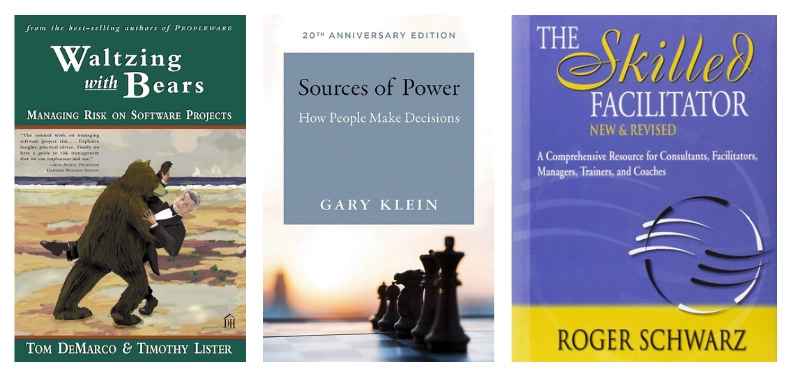
In the many chapters of good advice, there’s one called “Noticing What Isn’t There”. This is an important skill described in Gary Klein’s “Sources of Power” book about developing expertise. I’ve written a little about that before (see “How do you do that?” in my Agile in the Ether writeup). Examples of how to spot what’s missing in a new scenario:
- Keep track of things you miss; you’re likely to make the same mistakes in future. The author says “I’ve always had a problem noticing that nobody asked me for help in the first place.”
- “Find out what you usually miss and design a tool to ensure that you don’t miss it again.”
- Look for analogies from other areas.
- Move to extremes (what if costs doubled? What if all government regulations were suddenly removed?) “You don’t expect these things to happen, but playing with them in your mind distorts the current system and lets you see things that were previously concealed by reasonableness.”
Lots of other sections have good advice on identifying risks and handling them well — some of the advice there mirrors ideas from my all-time favourite risk management book, “Waltzing with Bears” by Tom DeMarco and Timothy Lister (I’ve written a little about this too, in How to disappoint people).
Another topic: Look for incongruence when you’re working with people or groups (”when words and music don’t go together”). The book recommends commenting on the incongruity – don’t try to interpret it, just bring it to their conscious attention. This reminds me of the “make low-inference assumptions” advice from “The Skilled Facilitator” by Roger Schwarz, a book I got a lot out of years ago and had almost forgotten about.