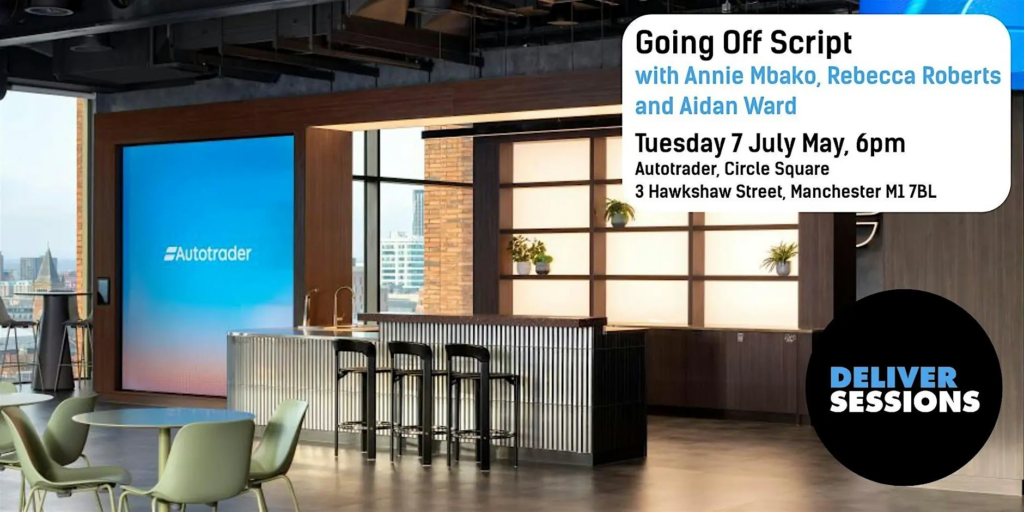
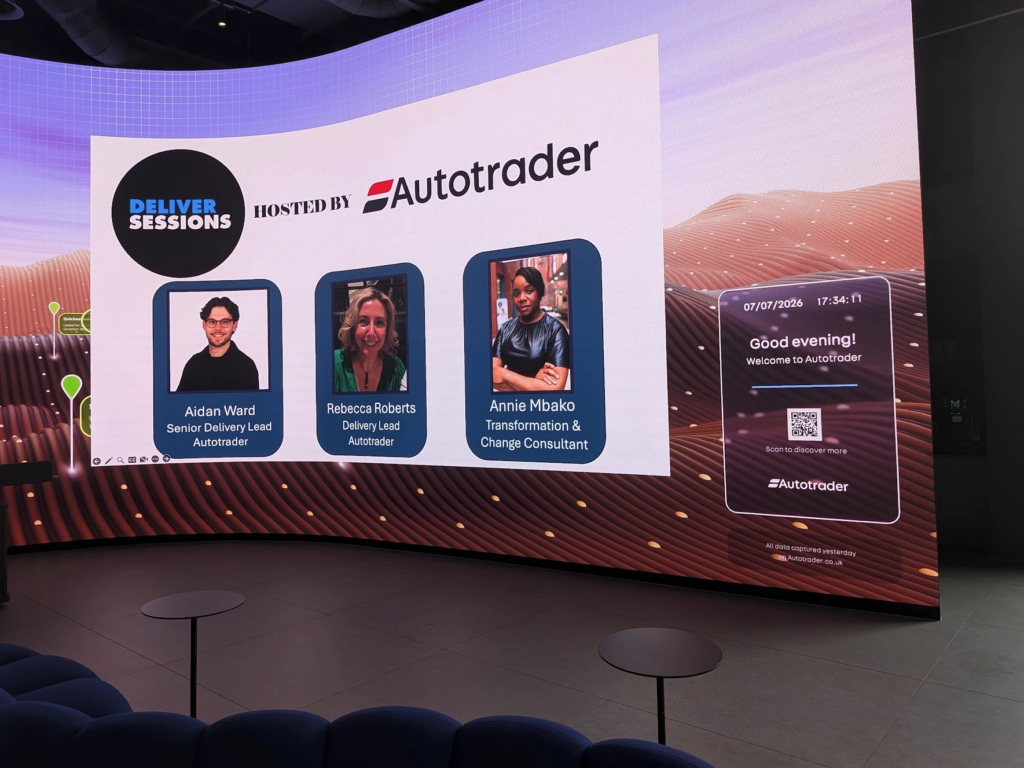
In July 2026 Deliver Sessions visited Autotrader’s new office in Circle Square. We were impressed with the welcoming entrance hall, featuring a huge curved screen with live Autotrader stats plus an overview of our meetup (with larger-than-life-size photos of our presenters, what a way to feel like a celebrity).
Retros by design, not by habit
“I hate retros.”
Aidan Ward was quick to clarify that he only hates the repetitive, performative types of retro that teams can accidentally fall into and find themselves getting no value out of. He’s tired of virtual trust falls, moaning about work, endlessly discussing our processes, scraping stickies off a wall, discussing your favourite cat picture.
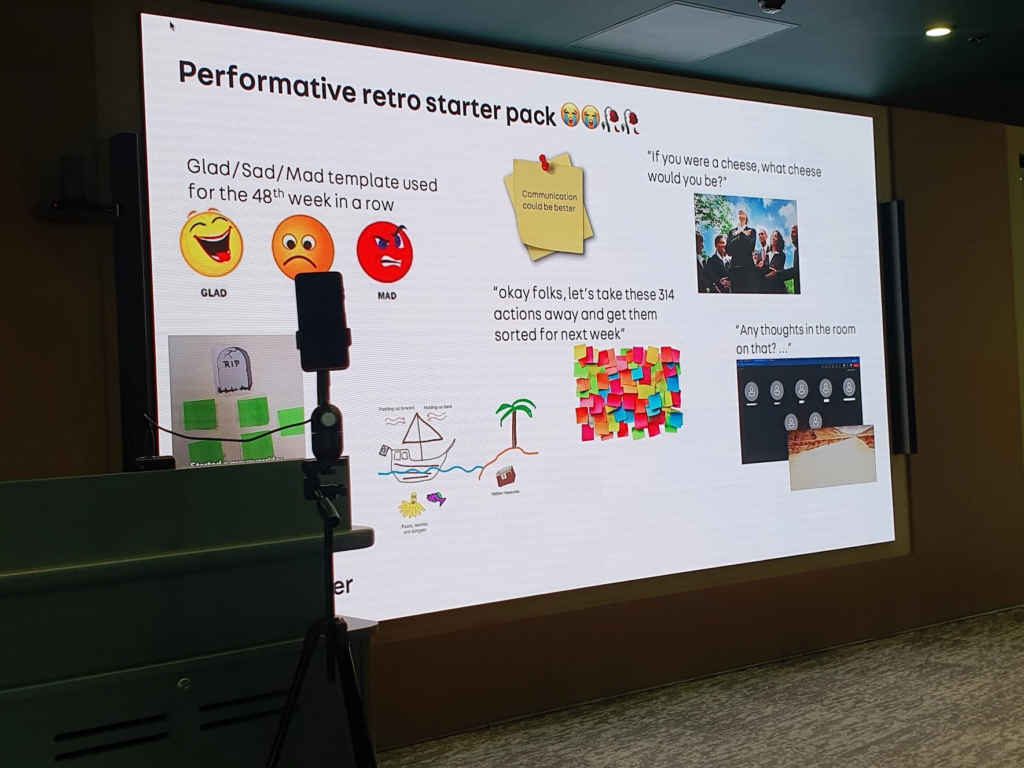
It’s easy to fall into this trap; none of these ideas are bad if used rarely and done well, it’s just that it’s too easy to keep reading from the same script and miss out on all the opportunities a better retro could give you.
Try:
- Discuss the problem, not the timeline. Instead of “what happened in the last two weeks”, keep notes throughout that time. Spot major pain points. Tailor a retro to focus on those.
- Read the room. If your team’s stressed, busy, excited about a recent big achievement, bear that in mind and match a structure to that.
- Bin the shopping list. Don’t come away with 100 huge vague actions, pick a very few micro-experiments.
Aidan shared practical examples of mistakes he’s made and successes he’s had when trying to make retros useful, then ended with a wall-sized “So what?” Alan Partridge gif.

He summed up:
- Make targeted retros that help the team discuss things they’ll find relevant and useful.
- Keep retros simple. If you need 15min to explain the format at the start, you don’t have a retro, that’s an escape room.
- Take a very few, small actions, and make sure they get done.
It’s not too late to be an apprentice!
Rebecca Roberts loves delivery management … but just a few short years ago she’d never heard of the role or ever worked in an office.
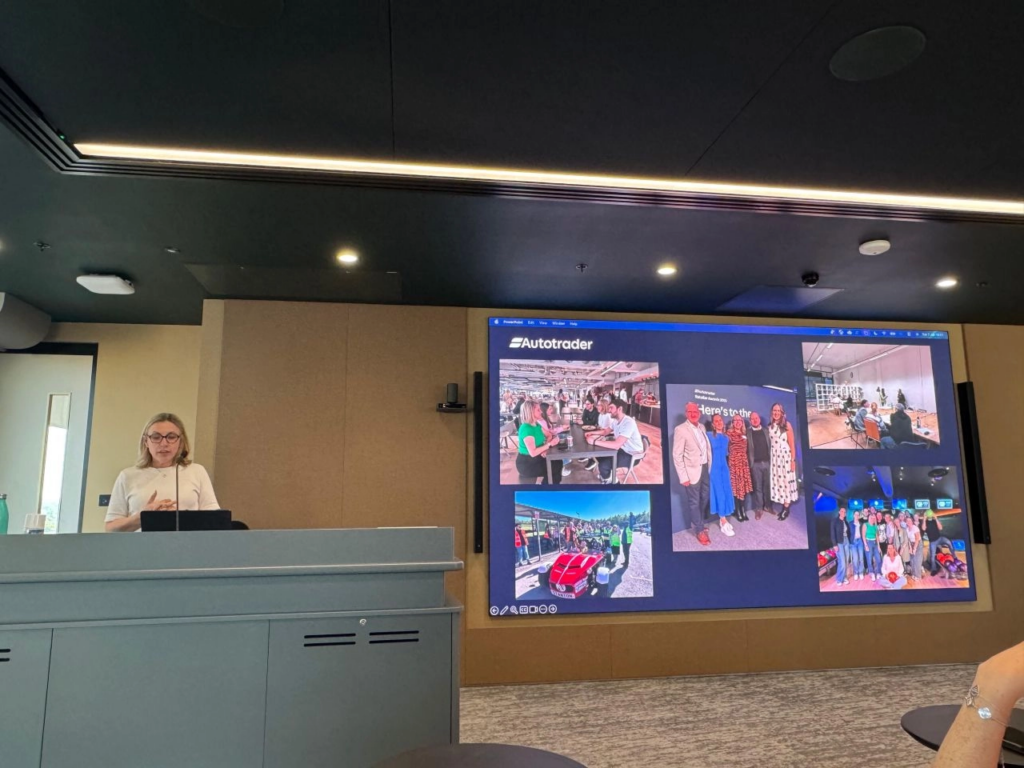
Becca worked as a flight service manager for Virgin airlines for 21 years. Never meant to stay so long but the discounted holidays and other perks really made it hard to leave. Then, COVID made that job disappear. Becca was willing to take any job available, working in a supermarket then an estate agent’s, before starting to reflect more on what kinds of things she loved doing at work and where she might find a career that let her do more of that.
A friend suggested that her list of skills and interests sounded perfect for delivery management for tech teams. Becca had never thought about working in tech and assumed a move like this was impossible with her experience so far, but has been delighted to find out that assumption was wrong.
- Autotrader offered an apprenticeship; these aren’t just for school leavers like you might think, UK apprenticeships nowadays also work for experienced people changing careers, senior managers gaining new skills, and more.
- This involved doing the actual job for most of the week — a daunting idea but Becca got lots of support and encouragement from colleagues.
- 20% of her week was for learning and working on job-relevant assignments, a great way to see lessons get applied right away.
Becca’s now a qualified delivery manager and encourages everyone to think about what they want from work — there might be some role you’ve never thought about that’s ideal for you. You don’t need to stick to whatever script you think your career has followed so far.
When agile goes off-script: A facilitator’s toolkit for staying on track
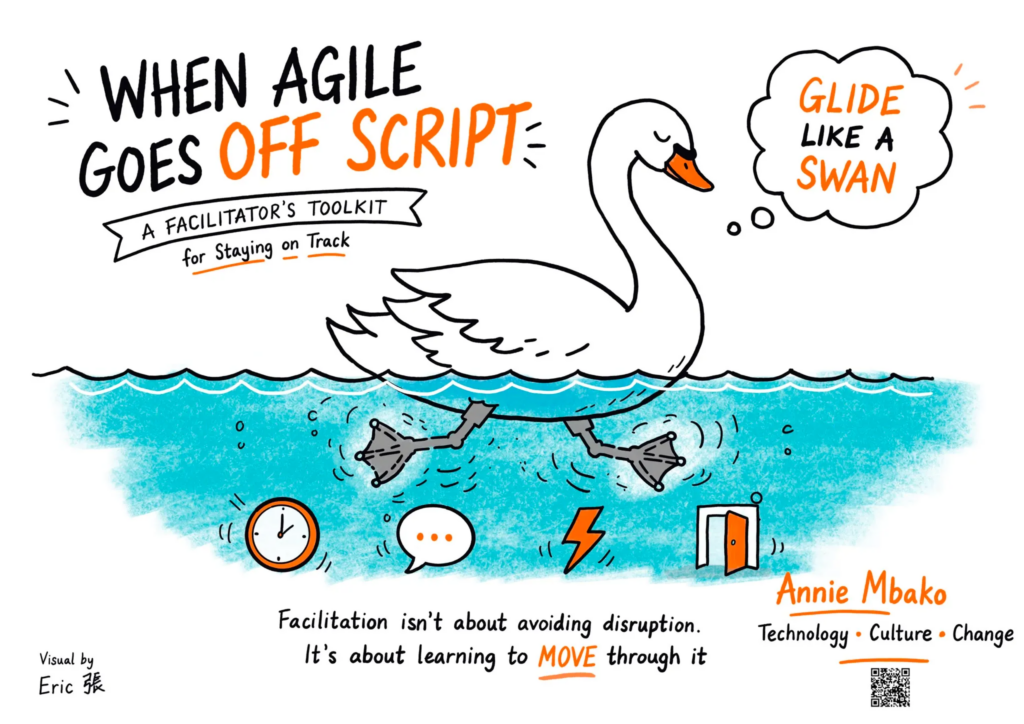
What happens when you’re asked to deliver a workshop and you have no idea how to structure it well?
What happens when the workshop starts late, is interrupted or disrupted suddenly?
What happens if you have to change location or lose the ability to present slides?These are all things that your friends Claude, Gemini and Chat GPT can’t really help with. Yet the vast majority of facilitators will experience one or all of these multiple times in their journey. So how do they cope?
The art of facilitation can be learned, just like any other skill. In this workshop, Annie will share tools and techniques that can help even the most introverted introvert glide like a swan.
— Annie Mbako specialises in the intersection of technology, culture and organisational change. She continues to refine her Facilitation skills as a tool to be used for both client and community engagement.
Annie told us compelling stories of facilitation skills — like the time she was on her way to co-host an important day-long client workshop and got a call saying the other facilitator’s train was hugely delayed. They decided to wait for him and start hours late. Despite this, they were able to shift around the planned activities (dropping, shortening, combining, adapting), still meet all the agreed aims and outcomes, and finish the day on time. This was a huge amount of work in the background, but to the participants it all seemed calm and effective.
How can we learn these magic tricks?
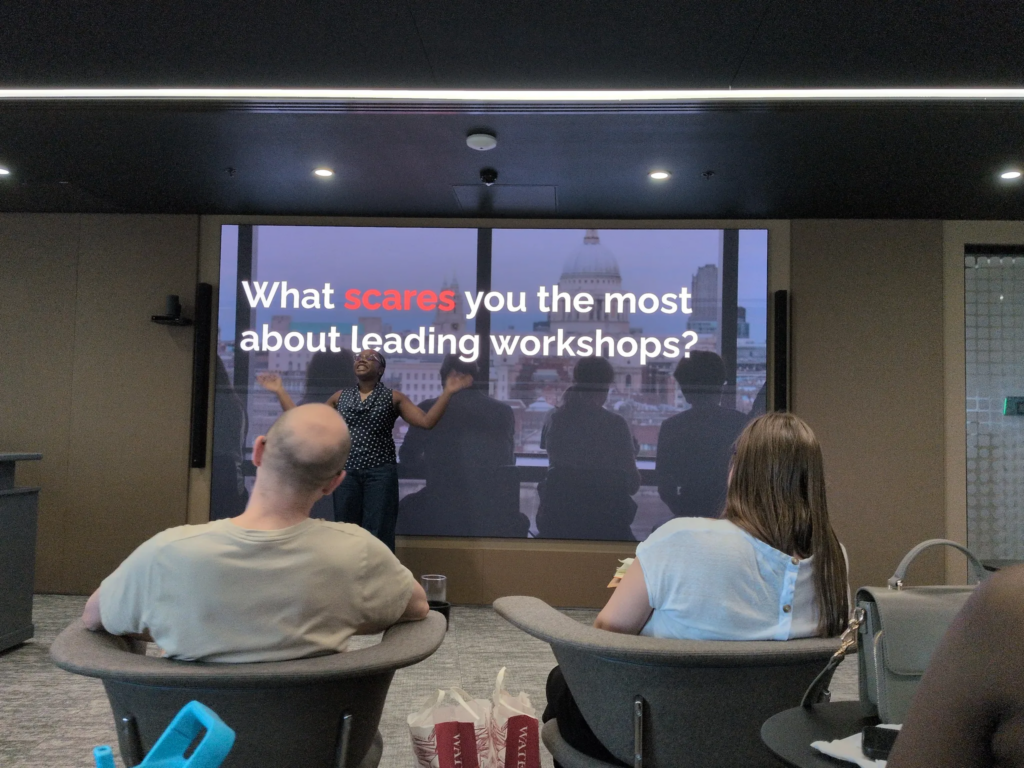
Annie: “I believe that confidence comes from preparation”. She recommended 2 tools for us to work on making our own: the schedule and the framework.
The schedule for a workshop is a very detailed plan: what are the activities, their exact timing, who’s going to facilitate it, what’s the outcome? Putting in the hard work to detail exactly how a workshop’s going to go gives you the flexibility to adapt gracefully and creatively to all kinds of surprises and setbacks.
The activities and exercises that make up a workshop aren’t too hard to come up with — SessionLab and lots of other sites have libraries you can pick from — but they can feel hard to use if you’ve never been given an overall structure on how a workshop comes together.
The framework Annie finds useful is one she learned from Mischief Makers: Launch-Explore-Land.
- Launch: You need to hear from people, so you know what they’re looking for. You can use this to tweak or refocus your plan. Could be a check-in, agreeing success criteria, IDOARRT…
- Explore: Collaborate to share ideas, create outputs, move towards the session’s goals…
- Land: How you bring the session to a close — will you collate learning, agree next steps, highlight a shared sense of achievement? Annie says the Landing doesn’t need to be anything spectacular, but it does need to feel intentional.
Annie used this framework to structure the session we were taking part in, letting everyone experience what each part feels like in addition to hearing the thinking behind it.
Next time at Deliver Sessions: You?
Autotrader’s lovely office is in Circle Square, a new neighbourhood in Manchester, on the site of BBC’s New Broadcasting House. Fans of Manchester history might like Skyliner’s article about the old building going, including the story of how local a bookshop ran a poll and sent the results as an open letter to the developers. Top choice was a massive ball pit — that reminded me of a blog post I wrote about facilitation and Boaty McBoatface.
We always appreciate getting to visit the many varied offices of Manchester’s tech community; do get in touch if you know somewhere that might like to host a future event.
And, if you’re interested in coming along as an attendee or a speaker, you should.
- Lots of attendees have been coming for many years, and are happy to share their experience as well as keep learning from others.
- Lots of attendees are just thinking about their first job in tech, and find this a welcoming way to meet some people and get a better idea of what work might be like.
- Speakers (and facilitators) also range from very experienced to first-talk-ever. We’re very happy to hear ideas and give whatever support would help. The Eventbrite page has all the organizers’ contact details, get in touch.
Next meetup date should be announced soon (follow the meetup on Eventbrite and/or LinkedIn). While waiting, you might like to read about past Deliver Sessions events.