I co-organise Deliver Sessions meetup along with Chris Burns and Zoe Rigley, and try to write a few notes after each one so I remember all the great topics we cover. For the September 2025 meetup, we got Matt Thornhill, one of the meetup’s founders, back as an attendee — next time we’ll need to see if we can get co-founder Shahina Patel over from Canada for another reunion.
This time, we were in Zühlke’s office in Piccadilly Basin, for 3 talks offering friendly advice on a range of tricky topics.
Taking the Oh S**t! Out of change
Can you recognise the difference between scope creep and positive change? Do you know when to challenge change and when to see its value?
By its nature, change is often unexpected. Lee will share some thoughts to help product and project managers plan and prepare teams and clients/sponsors for change, always trying try to avoid any ‘oh shit!’ moments.
— Lee Emery, product & optimisation practice lead
Lee started by asking about our favourite rollercoaster. For lots of people, a good rollercoaster ride is one where you can’t see far ahead, and sudden changes of speed and direction leave you shocked and possibly screaming. Not being able to see the path ahead is scary. These are good qualities in a rollercoaster, but work really shouldn’t feel like that.
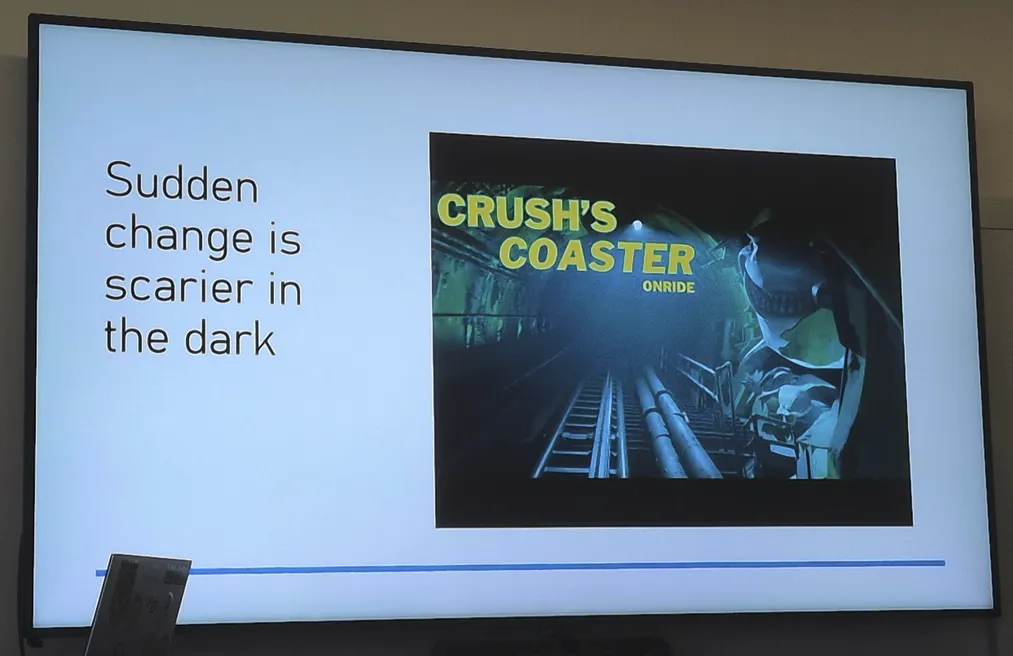
Lee says: “Whether change is seen as a good thing is largely down to how it’s presented.” If you can change your mind in response to new information, especially if it’s about learning why your original plans aren’t going to work or about spotting new opportunities for your product, that’s very appealing — and it’s a big feature of agile approaches. So, why doesn’t everyone do agile instead of more plan-driven, fixed approaches?
The key thing is trust. “It’s a lot more comfortable to have a list of what you’re going to get.” When you sign up to exploratory approaches, you don’t know what you’re going to get — you need to be OK with saying that to your stakeholders, bosses or investors — and you have to be a lot more present. You need to come out of your comfort zone, and feel safe to be challenged.
Lee toured through various practical real-life examples of helping to make change OK for people, and of getting benefits from it. She’s helped people test user needs with more effective research questions (people might say they want something, but can you be confident they’ll pay for it? And for how many people might this be a significant enough problem?). And she’s found the “desirable, feasible, viable” lenses (originally from IDEO) useful for discussing the value of suggested changes.
A final point: lots of clients and stakeholders do say they want to be flexible, quick to market, and meet user needs. But they need to be open, willing to share their motivations and challenges, and they need to be present. “You can’t react to change from a distant boardroom.”
“Good intentions, unintended consequences” – behaviour traps in delivery
In delivery teams, “tried and tested” behaviours can sometimes lead to unexpected consequences. This session explores the traps we can fall into when applying successful behaviours in new contexts.
We will explore behaviour traps, why they occur and how they can lead to unexpected impacts. We will dive into a couple of the most common behaviour traps seen in delivery teams and explore the principles and tools you already have in your toolbox that can help you navigate delivery traps.
— Nicky Riley, principal delivery consultant
Nicky opened with a story of how she once turned a difficult, risky piece of work into a huge success. She identified and filled lots of gaps, doing her best to use skills she definitely wasn’t expert in, and that weren’t in her job description, but that were needed for the work to succeed. Nicky was thanked, felt successful, and thought all this was great.
Later, on a similar-looking project, Nicky started filling all the gaps again and found a totally different outcome. Things weren’t going well but Nicky didn’t even realise — with skills and people missing from the team, she thought she could just work harder and get it all done. This led to very little getting delivered over quite a long time. She couldn’t understand how things and gone so badly.
Later still, after time to reflect, Nicky realised what she’d been doing. Behaviours had been ingrained in her, and she didn’t even think about making choices; if this happens, that fixes it, with no reflection about why that worked last time and what might be different here. Now, she’s much better at spotting where you have to stop and make sure we have the right team in place.
This is one of many traps Nicky’s fallen into and seen others struggle with too. Why does it happen? She described several ideas that have helped her understand better:
- “Past rewards write future scripts”: Operant conditioning from B. F. Skinner describes how we are trained by the outcomes we experience.
- “Old patterns feel like home”: Theory of reasoned action / planned behaviour from Martin Fishbein and Icek Azjen describes how we stick with behaviour that we think is “expected” and perceived better by others, and to shy away from new behaviours we might not perform well.
- “If it isn’t broke, don’t fix it”: Cognitive bias from Amos Tversky and Daniel Kahneman says we choose evidence that confirms our existing beliefs, reinforcing our current behaviours and making us dismiss contradictory evidence.
These all sound like great further reading topics!
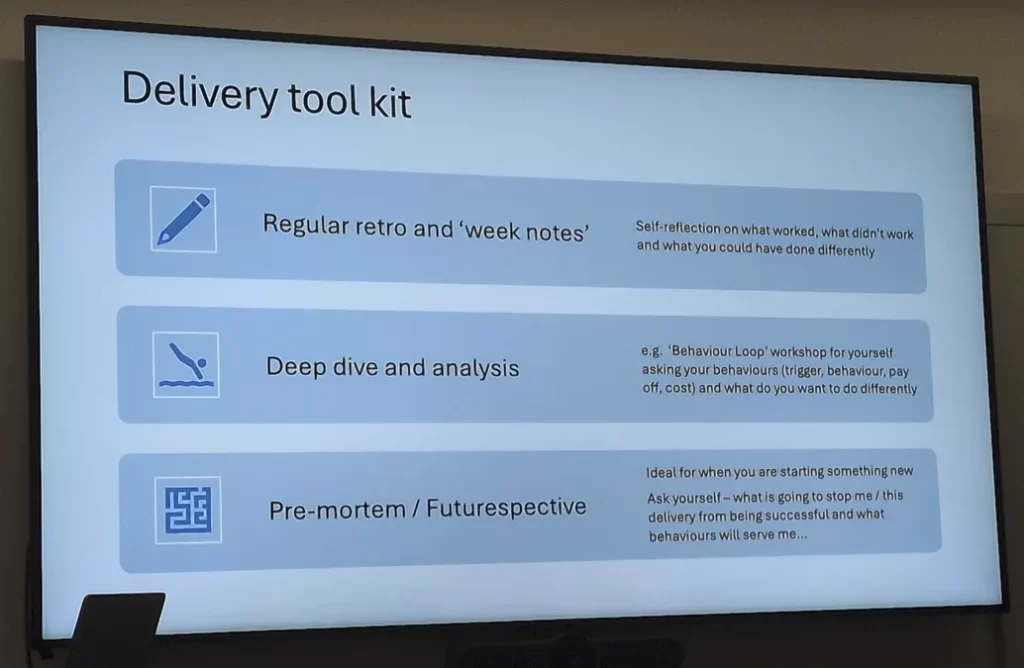
Nicky went on to describe how lots of the habits we use for improving software teams can also help you personally with watching out for traps like these — in addition to personal retros, weeknotes and futurespectives (I like these!), you could plan how to manage risks of known traps or how to run small, safe experiments to change habits.
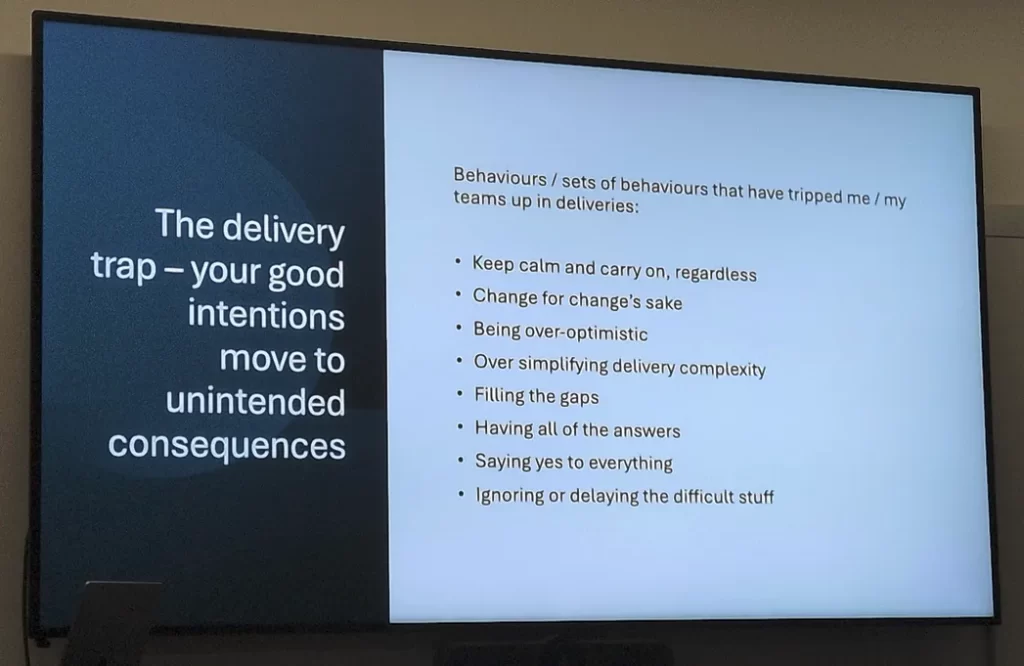
Once you start looking for them, there’s a huge range of traps that you might be falling into without noticing them. How many have you experienced?
Are you technical enough?
How technical do technical professionals have to be? Are you worried that you’re too hands-on, or not hands-on enough? Are you exhausting yourself trying to keep up with every technical detail in your domain?
Sometimes technical professionals worry they don’t have time to stay up to date with modern technology and / or the state of their team’s code base(s). Sometimes individual contributors are promoted to leadership positions and worry that they won’t be as hands-on as they used to be. Sometimes it’s the other way around: Somebody who has never been hands-on in the technical realm is given a technical position, and worries they’re “not technical enough”.
This talk explores the fears many people have around technical proficiency, as well as introduces several useful pieces of advice.
Takeaways:
— Clare Sudbery, Samman technical coach
- How to take a step back from “knowing all the things”
- How to make the most of the knowledge and experience of your team
- How to identify when technical knowledge matters, and when it doesn’t
- How to identify the things you need to know
- How to embrace the difference between individual contributor and technical leader
This is a topic Clare first started thinking about when she was part of a “Women Who Lead Tech” group: over and over again, this same worry came up. It didn’t matter how technical people were, how accomplished: there was a fear that they weren’t proficient, they didn’t know enough, and that everyone around them knew more. Since then, Clare’s heard it in more and more places: it seems that everyone, whether they’re in a minority or majority demographic in the tech industry, shares the same worry.
Clare runs a workshop that helps people explore this worry, come to terms with how technical they are, and make plans for what to do about it. I got to attend the workshop recently, and was pleased Clare offered to give this talk about what she’s found.
A first, important thing to realise: Leadership is more than being technical. If you used to write code and have been promoted, there’s less time for that now — you need to direct and mentor others, see what other teams are doing, and think about the direction of the product of the organisation. All of this takes time and new skills. It’s easy to forget that.
Clare recommends embracing changes in knowledge: you can get hung up on the things you used to know, or you can get excited about things that are taking their place. Also: surround yourself with people who know more than you. It doesn’t matter if it’s not in your brain, if it’s in someone else’s. This isn’t just something to be OK with, it’s something to embrace and rejoice in.
A way you can help yourself, and others on the team, is by helping people share their knowledge. Ask people to summarise things for you. This is a skill, and you can give support with it: how can they pull out the few, relevant facts from a wealth of detailed knowledge? How can interacting with diagrams together help understanding?
Clare’s also a fan of using questions to help everyone discover what matters.
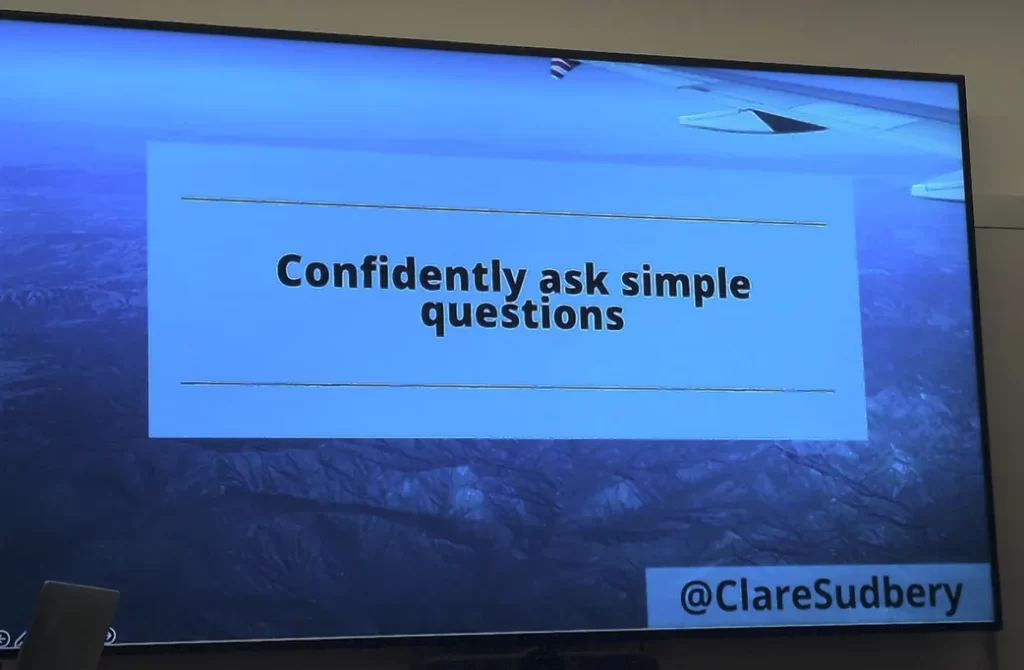
She says the way you ask questions makes a huge difference. There’s no need to apologise for not knowing something, or to say you’re wasting people’s time — not knowing is fine, and expected, and you confidently asking about things will help others easily ask about things they need to know. “In this industry, most people don’t know most things.”
Clare toured through a wide range of other helpful advice, including “Emphasise your strengths”. If you’re good at something and it enjoy it and it’s easy, you often disregard it. Don’t! Starting to pay more attention to the things she’s good at and enjoys (like public speaking) has made a huge difference to Clare’s career.
Clare left us with a handy page of links, including:
- Would you like to host the workshop that accompanies this talk?
- Subscribe to Clare’s newsletter
- Clare’s upcoming events this Autumn
More from the meetup
Deliver Sessions will be back soon! As always, you can register to get emailed when new dates appear, and read about past Deliver Sessions on this blog.
And to keep an eye out for meetups in Manchester (and around the North West), have a look at the North West Tech Calendar. There’s a lot going on! Gemma Cameron (who gave a great talk at the last Deliver Sessions) runs this calendar; please let Gemma or me know if you’re a meetup organiser and would like to add your events there.