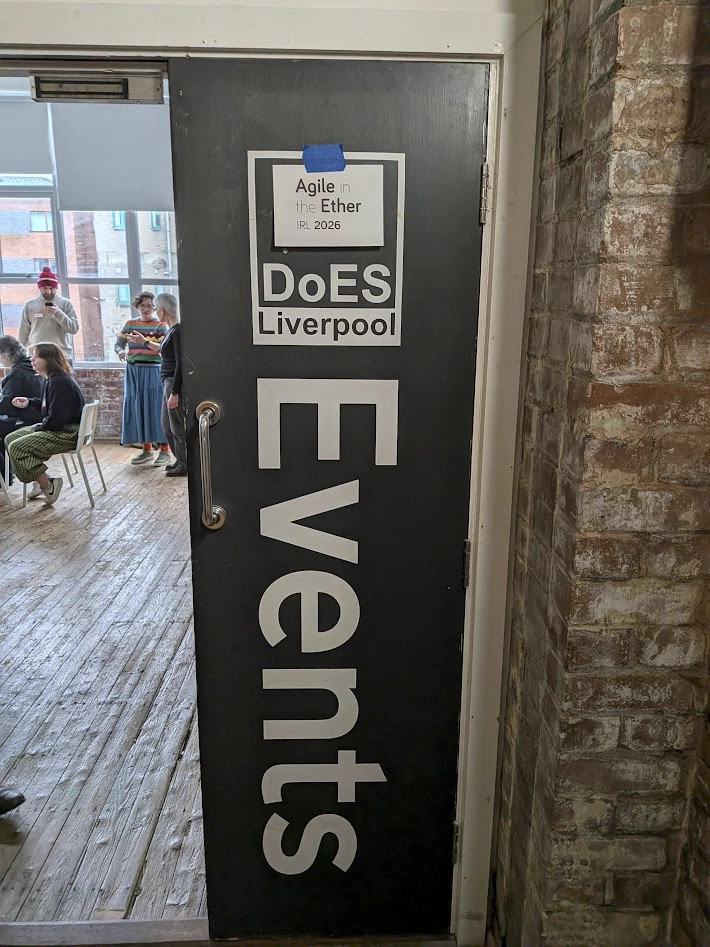
In February 2026 I went to Liverpool for Agile in the Ether’s 3rd one-day, in-real-life annual event. For lots of info on how the event worked and what sessions we had, see Emily Webber’s write up: Agile in the Ether IRL 2026: No Slides, Just Vibes.
I always come away from these events with piles of things I want to look into further, so this post is a handy list of links I can keep coming back to. Maybe other people will find something interesting here too.
The missing piece
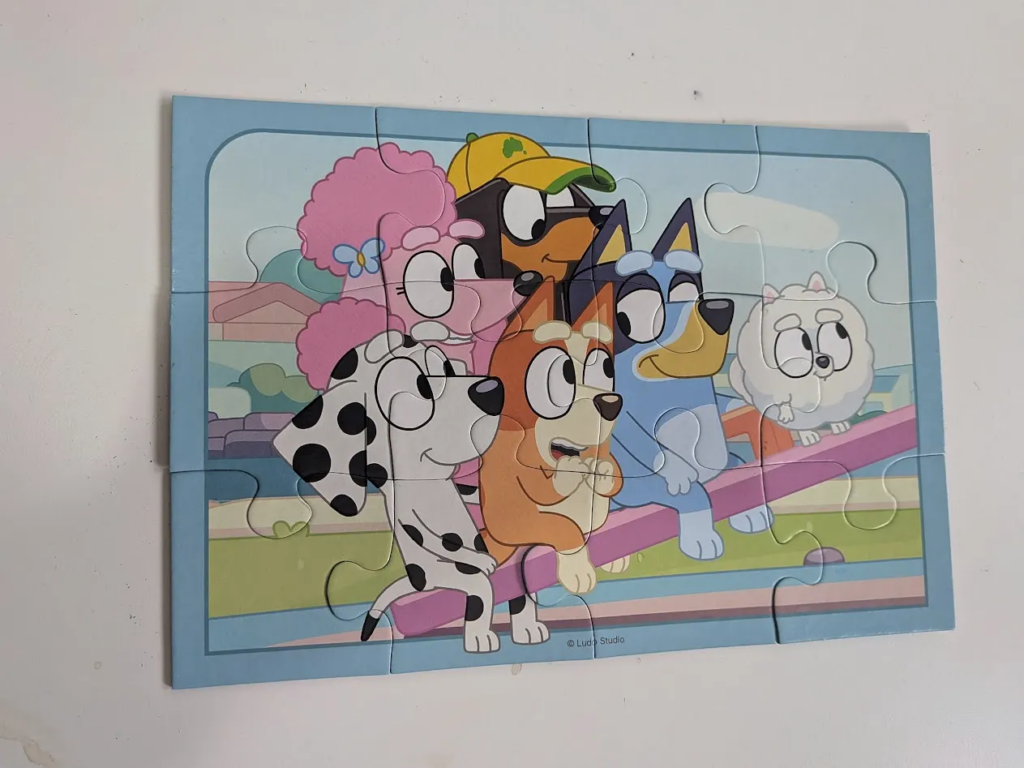
Katie Andrews let us try a workshop she’s run a few times: everyone gets one piece of a jigsaw, and needs to plan how the group will assemble it by each only discussing their pieces and how it all might fit — no showing!
This was a useful metaphor for all kinds of group activity, where having a way to show what we’re talking about or just being able to start work could clear up so many confusions. It definitely suits in-person workshops — feeling the physical pieces you’re working with and gathering round the puzzle together — but I’m always looking out for ways to make remote versions of things too. I’ve found a Miro jigsaw kit and a competitive Miro jigsaw challenge. Maybe you could give each person their piece on an individual board, or just on far-flung starting frames on one big board, before bringing the puzzle together centrally?
If jigsaw workshops help people realise the need for more shared visual understanding, what could you try next? I’ve got some leads:
- Emma Ainsworth gave a talk on Wardley mapping by stealth, using simple ideas to sneak people into using a whole complicated toolkit.
- Susanne Kaiser and Kenny Baas-Schwegler gave complementary talks at Lean Agile Scotland, focusing on big picture and specific details of using some nice visual techniques.
- Kenny’s talk there pointed me to Bytesize Architecture Sessions by Andrea Magnorsky, a fun format to start exploring how similar people’s understanding might be.
A taste of kishōkenketsu
Henny Bird introduced us to kishōkenketsu, a way of structuring stories that’s common in East Asia and very different than the structures commonly used in European or North American books, films and other narratives. Henny’s been learning how to apply this to planning and facilitating workshops. That’s fascinating, giving a satisfying structure to any group session can borrow a lot from storytelling, so learning more about how these work could give you all kinds of new ideas to try.

It’s a big new topic for a 45 minute session, so Henny aimed to let us experience just a few aspects of kishōkenketsu, then leave us to see if that’s piqued our interest to explore further. Since the session I have:
- Read articles from Francis Laleman, who gave Henny the idea of using this structure in facilitation — like this kishōtenketsu facilitation practice checklist.
- Watched a video about how Nintendo structures Mario levels.
- Started reading Spring, Summer, Asteroid, Bird, a book by Henry Lien that describes various Eastern storytelling approaches and sends you off to read books / watch movies / play video games before coming back to read his analysis of them. This is a very fun project.
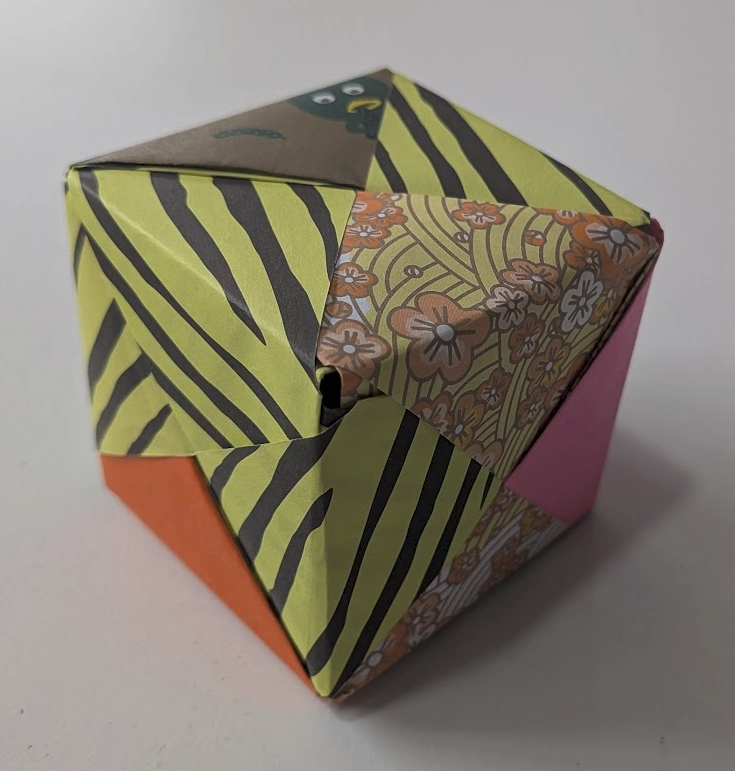
In act three of Henny’s session, we got a chance to make things in small groups. One of our group members had done some modular origami a long time ago, but had mostly forgotten how it worked, so we had a fun time of re-learning and teaching before making a paper cube the exact same size as a Rubik’s cube.
Lean coffee
Emily Webber organised a lean coffee discussion that left me with lots of things to read later:
- Burnout and disengagement are signals, not failures
- Remembering a team’s history and shared story can be helped by Architectural Decision Records, Project Stories, and a framework for thinking about team memory
- The BICEPS model can help when dealing with surprising human emotions
- Fearless Change Campfires are an annual remote event for hearing about change stories
- Advice: don’t ask forgiveness, radiate intent
- How to cope when you feel stuck in the middle between challenging stakeholders
- The meta-conversation, to help step up a level from repeated unproductive conversations
Algorithms IRL: Let’s solve a Rubik’s cube!

After lunch, I ran a session on how to solve a Rubik’s cube. That’s not a skill I’d looked into until a few months ago, when my son asked how it’s done and we watched a video to learn it. I was amazed that it’s a recipe you can learn, then further amazed as I looked into the various time / space / complexity tradeoffs people use to adapt the basic algorithm into something that can solve any cube in tiny amounts of time or moves. You can read lots more in my detailed post on cube solving, or maybe you’d like just a few video links:
- The tutorial I got started with: How to solve a Rubik’s cube in 8 steps.
- The human world record keeps improving. When I started writing this post, the fastest solve was by 7 year old Xuanyi Geng with 3.05 seconds, but by the time I published it was 9 year old Teodor Zajder with 2.76 seconds.
- The current robot world record: a blink-and-you’ll-miss-it 0.103 seconds. Apparently making sure the cube doesn’t explode is the hardest part, they built one with a bespoke core and extra-grippy plastic.
Can two people who’ve never met persuade you to use Clean Language by avoiding clunky questions, yes?
When Gemma Openshaw and Adam Maddison realised they were both interested in running sessions on Clean Language, they decided to team up and run it together — great idea, it meant we benefited from both of their perspectives and experience with it.
I’d heard the name before but never looked into it: Invented by David Grove for therapy initially, he’s encouraged other uses of the technique. It’s designed to avoid therapists (or coaches, or anyone) inserting too much of themselves into someone else’s story, and leading the conversation yourself. We practised using the “client’s” own words, and sticking to a very few question formats, to help make sure we weren’t unhelpfully bringing too much of our own metaphors and opinions to a the client’s challenge.
More info:
- Definition and motivation for Clean Language
- Book recommendation from the session: From Contempt to Curiosity, by Caitlin Walker
- A TEDx talk from Caitlin Walker that lead to her writing that book: Clean Questions and Metaphor Models
More from Agile in the Ether
If you’d like to come along to one of the regular meetup sessions, sign up for the mailing list.
To read about previous ether IRL events, see my notes from the 2025 edition and the original 2024 event.